A good-looking website isn't always a working website
Building a website with AI is surprisingly easy. Give it a few instructions and, within minutes, you've got a homepage with a nice design, a services section, testimonials and a contact form. It looks professional, so you publish it.
But once you start using the website, you might realise there's quite a bit missing.
Many websites generated with AI are essentially static HTML pages. They look good on screen, but there's little going on behind the scenes. That's not necessarily a problem if you're putting together a prototype or a simple landing page. For a business that needs to update content, manage enquiries or connect different tools, however, things can get complicated.
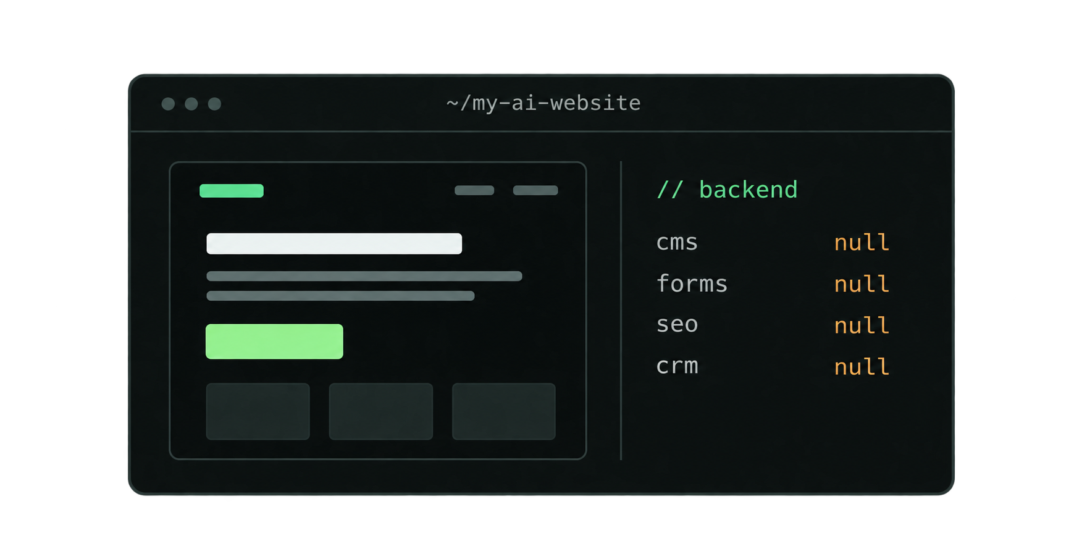
What happens when you need more than HTML?
We've seen this with businesses that come to us after building their websites using AI. They're happy with how the site looks, but as soon as they try to make changes or add new features, they run into limitations.
Some of the most common issues are:
- Updating content becomes a chore. Without a content management system, changing a price, adding a service or updating your phone number might mean editing the code. You can ask the AI to do it, of course, but even a small change can sometimes affect something else.
- There's no easy way to manage a blog. Publishing articles, organising categories and keeping content up to date requires additional development.
- Contact forms don't always work as expected. A form might look perfectly fine on the page, but that doesn't mean it's properly configured to send and deliver emails.
- SEO gets overlooked. Things like meta titles, descriptions, XML sitemaps and redirects need to be managed if you want search engines to understand your website.
- Analytics and cookie consent need proper configuration. Adding a tracking script is easy. Making sure it respects users' consent and meets European privacy requirements takes a little more work.
- Connecting other tools isn't straightforward. If you want your website to communicate with a CRM, email marketing platform, booking system or online store, you'll need to build and maintain those connections.
None of these things are impossible with an AI-built website. The question is how much work you're willing to put into developing and maintaining them.
The hidden work behind custom AI-generated features
Let's say you ask AI to build a contact form. Then you ask it to connect the form to your CRM. Later, you want to add a booking system, a blog or an online shop.
AI can help you build all of that, and some of it might work very well. But you're gradually creating a website with a collection of custom features that someone will need to look after.
What happens when your CRM changes its API? Or when a library used by your website has a security vulnerability?
With custom code, there's no guarantee that someone else is testing those same features or preparing updates. You'll need to keep track of potential issues, make changes and check that everything still works.
And if the person who originally built the website is no longer available, the next developer will need to understand how everything was put together.
We've worked on enough websites to know that maintaining custom code can take considerably more time than building it in the first place.
Why we still recommend WordPress
At CLOSE, we work with WordPress because it gives businesses a solid starting point without having to develop every feature from scratch.
You can update your pages through an editor, publish blog posts whenever you want and manage different parts of your website without touching the code.
And when you need something more specific, there's a huge ecosystem of plugins available.
Contact forms, SEO, cookie consent, multilingual content, e-commerce… These are features that WordPress developers have been working on for years.
There's another advantage worth considering: maintenance.
Established plugins are used across many websites, which means bugs can be reported by other users, updates are released and compatibility issues are addressed by their developers.
We know how much work goes into this because we develop and maintain WordPress plugins ourselves. Projects such as FrontBlocks, FormsCRM and Connect Ecommerce are part of our day-to-day work at CLOSE.
Of course, WordPress still needs maintenance, and choosing the right plugins matters. But you don't have to build and maintain every feature yourself.
Already built your website with AI? We can move it to WordPress
If you've created a website with AI and you're happy with the design, there's no reason to throw everything away.
At CLOSE, we can help you move your existing website to WordPress while keeping the parts you already like.
Here's what we can take care of:
- Keep your existing design. We recreate your pages in WordPress, respecting the look and content you've already developed.
- Make your website easier to manage. You'll have an admin panel where you can update content, publish articles and make changes without relying on AI prompts every time.
- Add the features you actually need. Contact forms, SEO tools, cookie consent and other functionality using established WordPress solutions.
- Take care of your SEO during migration. We review your current URLs, preserve them where possible and configure redirects when needed to minimise the risk of losing organic traffic.
- Connect your business tools. Whether you use a CRM, ERP, newsletter platform or e-commerce system, we can help integrate it with your website.
You'll end up with a website that looks familiar, works the way your business needs it to and can be maintained by other WordPress professionals.
Already have an AI-built website and want to make it more practical?
Get in touch with CLOSE and tell us what you've built. We'll take a look and explain what moving it to WordPress would involve.